EAN Webinar: Funding in Social Services – Experiences from Member States
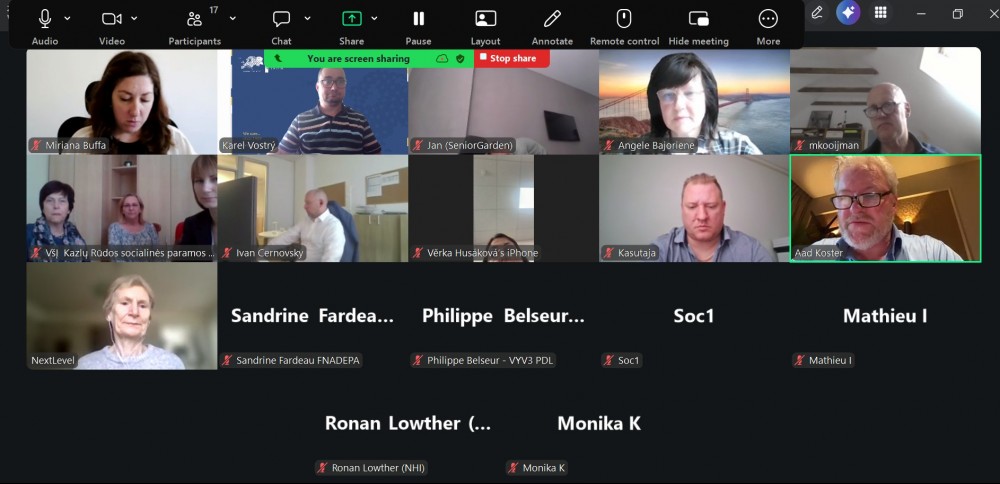
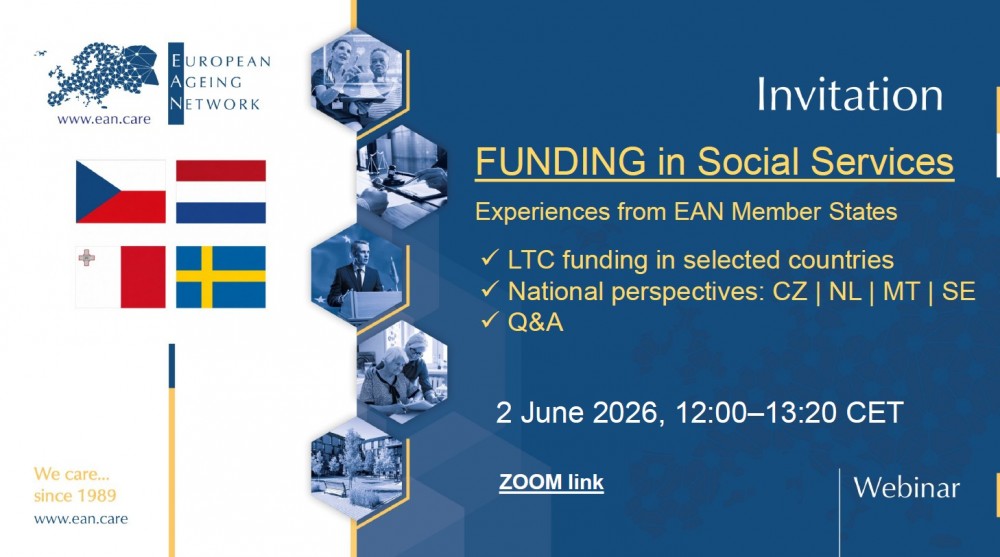 On 2 June 2026, EAN hosted a webinar titled “Funding in Social Services – Experiences from EAN Member States.” The event focused on long-term care funding in selected European countries and offered practical insights from the Czech Republic, the Netherlands, Malta and Sweden. After each presentation, participants engaged in a fresh discussion, allowing them to compare experiences, ask questions and reflect on similarities and differences between national systems.
The webinar provided an opportunity to compare different national approaches to financing long-term care and social services. Věra Husáková presented the Czech perspective, highlighting the combination of public subsidies, founder contributions, care allowance, client payments and health insurance payments. She also pointed to ongoing discussions on the interface between health and social care funding and the need for a more predictable and transparent funding model for providers.
Michiel Kooijman from ActiZ shared the Dutch approach, describing a system based on a patchwork of financial sources, including taxes, premiums, health and long-term care insurance, municipal funding and out-of-pocket payments. His presentation also addressed current developments such as ageing in place, reablement, family and community care, and the role of technology in home care.
Miriana Buffa presented the situation in Malta, where long-term care operates under a mixed funding model combining government funding, user contributions, private payments and public-private partnerships. The Maltese contribution underlined the strategic focus on expanding home and community care services in order to reduce pressure on residential care and hospitals.
The Swedish perspective was presented by Maria Mannerholm, who explained that long-term care in Sweden is mainly financed through municipal and local taxes, supported by national government grants and limited user fees. The presentation also highlighted the strengths of the Swedish system, including affordable care, individual choice of care provider and reduced dependence on informal carers, while also acknowledging the high cost of the system for society.
The discussions following each presentation showed that, despite different national funding models, EAN members face many common questions: how to ensure sustainability, how to strengthen home and community-based care, how to respond to workforce shortages, and how to make funding systems more predictable and transparent for providers.
A key takeaway from the webinar was that long-term care funding across Europe is becoming increasingly complex. While national systems differ, many countries face similar challenges: population ageing, workforce shortages, growing demand for residential and community-based services, and the need to ensure sustainable, transparent and fair funding mechanisms.
The presentations from the webinar are available in a single PDF file below.
Download the presentations (PDF)